Strategy & Direction

Most strategic
planning is theater.

Everyone gathers, someone facilitates, sticky notes accumulate, and a document is produced that nobody references again. The reason is almost always the same: the room reached for solutions on day one, before it had told itself the truth.

We facilitate discernment instead — not consensus, not top-down. It takes longer, it's harder to sit in, and it produces convictions an organization will still be operating from in fifteen years.
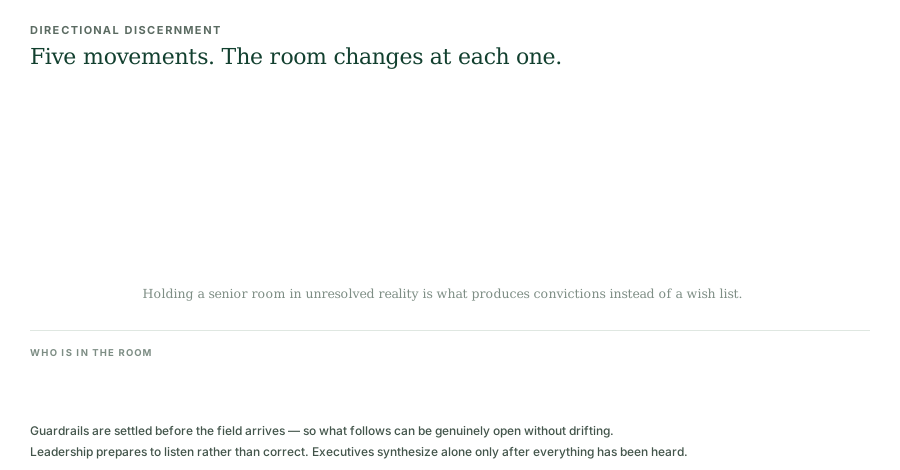
Directional Discernment: five movements from framing through commitment, with the room composition changing at each stage
Directional Discernment™ — the arc of a multi-day gathering.
The three design decisions

What makes it work isn't the content.

Guardrails before openness

Leadership settles the non-negotiables privately first, and names them as guardrails rather than strategy. That's what lets everything afterward be genuinely open without drifting — and it stops leaders from quietly overriding the outcome later.

The room changes deliberately

Leadership alone. Then leadership and the funding arm. Then everyone, with field leaders speaking first and executives instructed to listen rather than correct. Then back to leadership. Who is present is a design decision, not a logistics one.

Solutions are forbidden

For several consecutive days, no decisions are permitted — only reality, patterns, and tension. Holding a senior room in unresolved reality that long is the hardest thing in facilitation, and it's the only thing that produces convictions rather than a wish list.

Underneath all of it is a repeating daily rhythm — the same shape every day, so nobody spends energy wondering what's coming next. Predictability in the container is what allows depth in the conversation.

What you walk out with

Four to six convictions. Not a binder.

A directional conviction is a statement an organization can hold for fifteen or twenty years and test decisions against — more durable than a strategy, more specific than a value.

01Directional convictions, stress-tested against governance, policy and real constraints
02A shared, honest picture of field reality — including what leadership couldn't see from a distance
03Documented success patterns from appreciative inquiry: when the work is at its best, and why
04A stop, start, pilot and study list with named owners
05Clear separation between what emerged and what was actually decided
06A drafting plan and timeline for the long-range vision that follows
Shorter engagements

Four workshops that stand alone.

Not every organization needs a multi-day gathering. Each of these runs as a focused workshop — and each is a component of the full process.

Theory of Change

Problem, intervention, outcome, impact — drawn out and written down. The real work is surfacing the assumptions sitting between each link, because that's where programs quietly fail.

Read the guide first →

Vision, Mission & Values

Declared rather than debated. If three senior leaders answer “why do we exist” three different ways, nothing downstream can be aligned. This is Layer 1 of the Flourishing Framework, done properly.

Behavioral Values

The workshop most organizations skip, and the reason values posters mean nothing. We translate each stated value into observable behavior — what it looks like when someone does it, and when they don't.

Logic Model & Measurement

The bridge from intent to evidence. Indicators tied to outcomes rather than activity, built to survive the scrutiny of a serious funder.

Honest about the cost

This is not a light engagement.

A full discernment gathering takes ten days or more in one place, with senior leaders and field leadership present for most of it. It requires an executive team willing to hear things they'd rather not, and a board willing to let direction emerge rather than be presented.

If your organization isn't ready for that, the shorter workshops are a better place to start — and we'll tell you so rather than sell you the larger thing.

“Discernment. Not consensus, not top-down.”

Consensus produces the least objectionable option. Top-down produces compliance. Neither produces conviction — and conviction is the only thing that survives a hard year.